
Excuse Our French, but F*CK Feminism
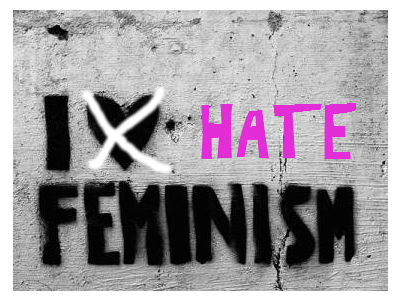
by D.Z. Walker & C.C. Mendoza
When I was younger and full of self-doubt, the ideology of feminism resonated with me. I was growing up in a community where I felt invisible apart from my breasts and other sexual assets. I felt seen for all the wrong reasons. Much like Ralph Ellison’s invisible man, I was the invisible girl.
For any girl who feels like nothing, feminism appears to be a magic anecdote. You supposedly become aware of the power you possess and the joy of what it means to be an independent woman ready to excel and flourish in a male dominated world. It is a lovely space to be in until you realize that you are not just a woman. You are a Black Woman and there is no place for you in the state of white feminism. Their solidarity is their own. In that moment, you become a double minority: Black and female. They see your independence as aggression and your tenacity as an inability to know your place.
You quickly learn that you are not in a male dominated in world. You are in a world dominated by white women and in this world; you are less visible than you were in your old state of being.
I do not know if the exclusion from the camaraderie of sisterhood was intentional. I’d like to think it wasn’t, but the truth is that it was always their movement. Black women could psychosomatically enjoy the endorphin rush of independent thinking, but the reality is that construct was not ever really designed for us to begin with. From a political standpoint, the feminist movement had unforeseen repercussions for black women because it forced us to contend in corporate America before we fully learned how to contend in our own families and communities.
Why? Simply because in a society filled with not only racism, but also sexism, our men need us differently than white men need their women. White men have always held the principled state of head of household for millennia making it safe for his women to venture out and seek independence and revolution. In America, the Black man has had a short tenure as head of household, if ever. Welfare laws in the 1960s and 70’s, at the height of the feminist movement, banned the presence of a man in the home.
Black families working through financial turmoil, at those times, because of lack of education, housing and job opportunities were forced to pretend the unthinkable. We pretended our men were not there in exchange for cash assistance, food stamps and affordable housing. Only to discover a generation later, it became a self-fulfilling prophecy and as a result, our men still are not home.
The same movement during the 1960’s that fought for equal pay for women, a woman’s right to abort her child and for a woman’s right to an education has not benefitted us the way it did our white sisters. Rather the feminist movement pulled us away from our children and away from our men during the time that they needed us most. It provided this fallacy where we could do it on our own. To the contrary, while white women were trying to become part of the greater American nation, African Americans, Hispanics and even many Asians were building a nation. We were fighting for civil rights, fighting for education and equal housing. We were fighting for our communities when we were abruptly pulled away and given the “you can do it on your own” fallacy. We began our ascension up the corporate ladder and away from our men and children. We leaned way too far in. The post-feminist world is not ours, yet. It will belong to us when we can pull up our sons, brothers and husbands with us. This is a circumstance white women do not have to contend because their men reside at the top of the food chain.
Now, we’ve progressed as a nation over the passed 40 years, but the backlash of the feminism movement is still at work in our homes.
Yes, we are ascending the corporate ladder, but our communities are in decline. We believe the erroneous notion that our men are not dependable and we can raise children on our own because we are STRONG BLACK WOMEN. The same feminist principles that propelled white women forward, both socially and economically, have held our entire family unit back.
For this reason, I cannot call myself a feminist. I consider myself a womanist who is not intimidated, threatened or jealous of my brother’s ascension to success. I have come to understand that grace, beauty and the mind of a Black woman are even greater in complement to the Black man. Feminism seeks to build the individual woman. The reality is that we need our families restored and that cannot happen with women thinking only of themselves and not the fruit of their womb and their male counterparts. No, we can’t have it all, but if we don’t learn to focus and think of things from how our decisions impact the entire unit, we won’t have anything.
As women of color, we may have been excluded from the conversation on feminism, but our communities and families have not been excluded from the by products of its aftermath. It’s not a question of women being better than men or men being better than women. It is now a question of how can we best work together to restore familial stability and give the next generation more inclusion and solidarity than we had.